
Here's the catch. Many homeowners fall in love with this tree at an arboretum, then spend months searching for a healthy specimen at a garden center, only to come up empty or find an overpriced, root-bound sapling. Paperbark maple is genuinely hard to propagate, which means supply rarely meets demand.
This guide covers where the tree comes from, what it needs to thrive, how to use it in your landscape, and where Pennsylvania and Delaware homeowners can actually source a quality, transplant-ready specimen.
Key Takeaways
- Exfoliating cinnamon-copper bark peels in curling layers for year-round interest.
- Reaches just 20 to 30 feet at maturity, suited to smaller residential lots.
- Adapts to USDA zones 4-8, clay soil, and full sun or partial shade.
- Low seed viability (often under 5%) means it stays exactly where you plant it.
What Makes Paperbark Maple Special?
Three traits set this tree apart from every other maple in the landscape: bark that peels like parchment, foliage that shifts through the seasons, and a backstory rooted in remote Chinese mountainsides.
The Iconic Exfoliating Bark
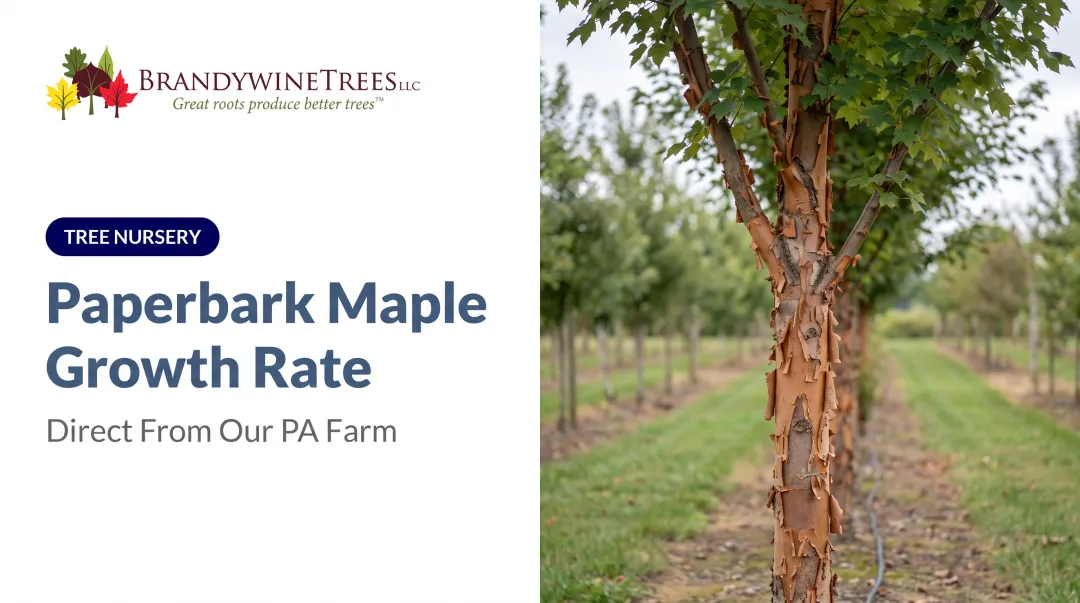
The bark is the whole reason people plant this tree. Thin curls of cinnamon, copper, and russet peel back from the trunk and larger branches, clinging on rather than shedding messily onto the lawn.
According to Virginia Tech's extension guide on paperbark maple, peeling typically develops on branches roughly a half-inch or larger in diameter, and both the color intensity and the amount of exfoliation vary noticeably from tree to tree. Some specimens peel dramatically; others hold on to more bark than you'd expect.
A few other landscape trees peel too, but paperbark maple stays the most consistent and colorful of the group, especially in winter:
- River birch: curling, papery sheets of tan and cream
- Kousa dogwood: a puzzle-piece bark pattern that develops with age

Trifoliate Leaves & Four-Season Color
Unlike the single-bladed leaves of most maples, Acer griseum produces a trifoliate leaf: each leaf is three coarsely toothed leaflets. Flip one over and you'll notice a distinctive gray-green cast underneath, fine and almost frosted in texture.
That grayish tone is exactly what gives the species its name: griseum comes from the Latin griseus, meaning gray.
The seasonal show doesn't stop there:
- Leaves emerge in spring and mature to a deep green through summer
- Fall brings a shift toward bronze and red-orange, though the intensity varies by tree and by sun exposure
- Paired samaras (the winged seed pods) often persist on bare branches well into winter, adding subtle texture once leaves have dropped
A Rare Chinese Native with a Storied History
Paperbark maple isn't a garden-center invention. It's native to mixed forests in the mountains of central China, including Hubei, Shaanxi, Gansu, and several neighboring provinces, generally at higher elevations.
Plant explorer Ernest Henry Wilson introduced the species to the West twice: first in 1901 for the Veitch Nursery Company, then again in 1907 for the Arnold Arboretum. That second introduction consisted of just two plants. For most of the 20th century, nearly every cultivated paperbark maple in Western horticulture traced back to that narrow genetic pool.
That's changing. A 2015 NACPEC expedition documented by the Arnold Arboretum sampled 66 trees across nine wild populations in six Chinese provinces, collecting seed, herbarium material, and leaf tissue to broaden the genetic diversity of cultivated stock. Progress is slow, but growers are gradually gaining more diverse stock to work with.
Growing Conditions: Sun, Soil & Growth Rate
Good news for Mid-Atlantic gardeners: this tree is well-matched to our climate, provided you get the siting right.
Hardiness zones. Paperbark maple is generally rated for USDA zones 4 through 8, with some regional sources narrowing that to 5-7 for best performance. Pennsylvania and Delaware fall comfortably within its range.
Sun or shade? It tolerates full sun to partial shade. Trees grown in fuller sun tend to develop more vivid orange-red fall color, while part-shade specimens lean more yellow. Give it as much sun as your site allows for the strongest seasonal display.
Soil needs. This is where a lot of new plantings go wrong. Paperbark maple:
- Tolerates clay soil and a range of pH levels, from acid to somewhat alkaline
- Requires consistently moist, well-drained soil — it does not handle drought well
- Appreciates supplemental water through dry summers to keep foliage crisp
Growth rate. This is a slow-to-moderate grower, typically adding less than 12 inches of height per year. The biggest variable in how quickly a young tree fills out isn't fertilizer or pruning. It's root health at planting.
A tree with an intact, well-developed root system establishes faster and pushes more growth in its first few seasons. One dug from a field and stripped of most fine feeder roots lags behind.
Mature size. Expect an oval to rounded canopy reaching 20 to 30 feet tall, grown as either a single-trunk or multi-trunk form depending on how it's trained early on.

Landscape Design Ideas for Paperbark Maple
Because it stays relatively compact and offers something to look at in every season, paperbark maple earns a spot in landscapes where space is limited but visual interest isn't optional.
Design uses that play to its strengths:
- Specimen tree: Plant near a patio, entryway, or a window you pass often. The bark rewards close, repeated viewing in a way most trees don't.
- Street tree or foundation planting: Manageable mature size and tolerance for imperfect urban soils suit walkways, driveways, and foundations where larger shade trees simply won't fit.
- Winter focal point: Against snow or a gray Mid-Atlantic sky, the cinnamon-copper trunk is often the most colorful thing in the yard—with no extra upkeep.
Care, Maintenance & Common Concerns
Once established, Paperbark maple asks for very little ongoing care.
- Low-maintenance overall — famously trouble-free in most landscapes, and only light shaping cuts when needed
- Stays put — up to 95% of samaras are inviable, so it never wanders beyond where it's planted
- Planting depth — roots stay close to the surface, so setting the root flare at grade is the detail that matters most
Get depth right at planting:
Keep the root flare—where the trunk widens into the roots—at or slightly above the soil line. Apply 3 to 4 inches of mulch in a wide ring, keeping it off the bark. That buffers surface roots from temperature swings and moisture loss without smothering them.
Why Source Your Paperbark Maple from Brandywine Trees
Because paperbark maple is difficult to propagate, where you buy the tree matters more than it does with most ornamental species.
We understand the propagation challenge firsthand. Brandywine Trees' Licensed Growers and Certified Arborists work with root health and germination challenges every day. For a species where light-grown cuttings root at rates as low as 10-18%, that experience shapes how every tree in our inventory is developed—from seedling through each pot-up stage.
Our Transplant Ready Trees™ standard fits a slow grower like this one. Each specimen goes through two to three root-pruning pot-up stages in a custom organic growing mix, with mycorrhizae added to support nutrient exchange. The result is a fibrous root system that can retain up to 100% of its feeder roots at delivery.
For a species that already grows slowly, a healthy, undamaged root system is the single biggest factor in how quickly it takes hold in your yard.
What you get working with us directly:
- Wholesale pricing on orders of three trees or more, mixed and matched across any variety
- Direct-from-grower transparency — we know the growth history of every tree we sell, since we propagate more than 90% of our stock ourselves
- Access to rare, collector-prized varieties like paperbark maple, rarely found at typical garden centers
- Delivery throughout Pennsylvania and Delaware, with optional planting service through our preferred contractor for quantity orders
Paperbark maple is available at $159 to $189 per tree, depending on size, from 10-gallon containers up to 7-8 foot specimens.

Frequently Asked Questions
How quickly does Acer griseum grow?
It's a slow-to-moderate grower, typically adding less than 12 inches of height per year. Trees with healthy, intact root systems at planting establish faster and reach a mature canopy sooner.
Do paperbark maples prefer sun or shade?
They thrive in full sun to partial shade. Full-sun trees generally develop more vivid orange-red fall foliage, while part-shade trees tend toward yellow tones.
Does paperbark maple spread?
No. Roughly 95% of its seeds are inviable, and even professional growers find it slow to propagate, so it stays neatly where you plant it.
What USDA zones is paperbark maple suited for?
It's rated for zones 4 through 8, with some sources narrowing the ideal range to 5-7. It's well-suited to Pennsylvania and Delaware climates.
How tall does a paperbark maple get at maturity?
Most mature trees reach 20 to 30 feet, with an oval to rounded canopy. Some sources cite a slightly smaller range of 15 to 25 feet, depending on growing conditions.
Why is paperbark maple more expensive than other maples?
Low seed viability and difficult propagation limit how many nurseries can grow it in volume. That scarcity, combined with slow growth rates, keeps supply tight and prices higher than common maple varieties.