
Introduction
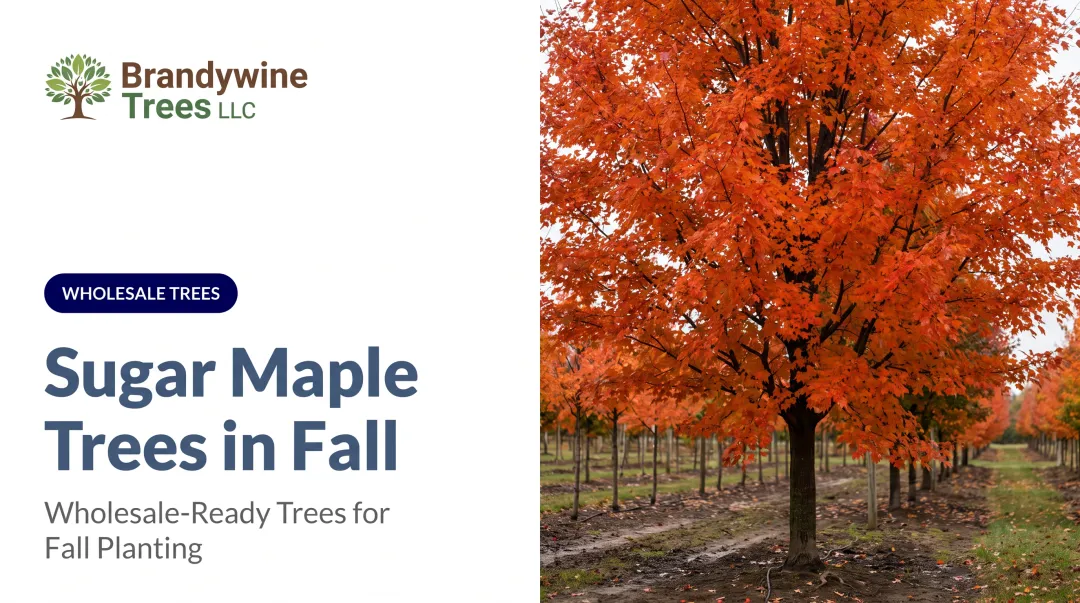
Every October, a mature sugar maple looks like it's on fire. Its canopy blazes amber, scarlet, and gold from a single trunk that's stood through generations of harsh northeastern winters.
Acer saccharum has shaped culture, cuisine, and commerce across the northeastern U.S. and eastern Canada for centuries, long before it became a landscape favorite.
Homeowners plant sugar maples for unmatched autumn color and deep summer shade. The same species is the sole commercial source of real maple syrup—a sweetener so labor-intensive that a single gallon can retail for well over $35. Getting the tree right still matters: misidentification is common, and poor siting or planting can waste years of growth.
This guide covers how to identify a sugar maple, why it holds cultural weight from state capitals to Canada's national symbols, why maple products command a premium, and how to plant one so it establishes well. For homeowners and landscape professionals in PA and DE, it also notes what Transplant Ready stock from a regional grower such as Brandywine Trees means when you are ready to source trees.
Key Takeaways
- Sugar maples reach 60-75 ft in landscapes and can live 200-300+ years
- Fall color and syrup production give this species major cultural and economic value
- Producing one gallon of syrup takes roughly 43 gallons of sap
- Sugar maples grow best in zones 3–8 when soil stays well-drained and cool
- Root health at planting time largely determines how fast a young tree establishes
What Is a Sugar Maple Tree?
The sugar maple (Acer saccharum) is a long-lived hardwood in the Sapindaceae family. It grows natively across eastern and central North America—from the Canadian Maritimes through the Appalachians into Georgia, and west to Minnesota and northeastern Texas.
Size, Growth Habit & Identification
Landscape-grown sugar maples typically reach 60-75 feet tall with a 40-50 foot spread. Forest-grown specimens climb higher, up to 90-120 feet, with trunks measuring 30-36 inches in diameter at maturity.
Identification basics:
- Leaves: opposite, five-lobed, 3-5 inches long, with U-shaped sinuses between the lobes
- Buds: brown, sharp-pointed, with dark-margined scales
- Sap test: clear sap from a broken leaf stem (Norway maple bleeds milky white sap)
Bark, Longevity & Champion Trees
Young sugar maples show smooth, pale gray-brown bark. With age, that bark furrows into thick, shaggy plates. It's part of what gives older specimens their rugged, storybook look.
Sugar maples regularly live 200 to 300 years, and healthy forest stands have been documented at 300-400 years. American Forests' national champion, growing in New London, Connecticut, stood 124 feet tall with an 86-foot crown spread as of its 2013 measurement.
What's in a Name?
You'll hear sugar maple called rock maple or hard maple, references to its dense, durable wood. Some regions also use the folk names sugar tree or sweet maple, though those are informal rather than botanically documented terms.

What Makes the Sugar Maple So Special?
No other large shade tree pulls off quite the same trick: brilliant fall color, syrup production, and premium lumber, all from one species.
The multi-hued autumn display comes from pigments already present in the leaf. As chlorophyll breaks down each fall, yellow and orange carotenoids and red anthocyanins take over, creating the yellow-to-red gradient sugar maples are famous for. That display fuels a substantial tourism economy across New England and eastern Canada every autumn.
Cultural symbolism runs deep:
- Official state tree of New York, Vermont, West Virginia, and Wisconsin
- Central to Canada's national identity and maple symbolism
- The species behind virtually all commercial maple syrup and sugar production
Beyond the sap, sugar maple lumber is a premium hardwood used for:
- Furniture, flooring, and veneer
- Tool handles, cutting blocks, and gunstocks
- Bowling pins and musical instruments
That mix of fall color, syrup, and durable wood is why so many landscapes and working forests still center on this one native species.
From Sap to Syrup: Why Maple Products Carry a Premium Price
Anyone who's paid $15 for a small bottle of real maple syrup has wondered why it costs so much more than corn syrup or agave. The answer starts with physics.
The Freeze-Thaw Mechanism
Sap doesn't flow on demand. It flows because of pressure changes inside the tree.
Freezing nights create negative stem pressure that pulls water up from the soil. Warming days flip that pressure positive, pushing sap out through a taphole. Without that freeze-thaw cycle repeating through late winter, there's no sap season at all.
The Conversion Ratio
According to Cornell Cooperative Extension, sap averages about 2% sugar. Producers need roughly 43 gallons of sap to boil down into just 1 gallon of finished syrup. That's a massive amount of wood-fired or oil-fired evaporation for a relatively small yield.
What the Market Actually Pays
The math translates directly into price. USDA's most recent crop report puts the national average maple syrup price at $35.60 per gallon for 2025, with total U.S. production value hitting $203 million that year.
Hard maple lumber commands its own premium. Pennsylvania's Q3 2025 timber market report lists standing sugar maple stumpage averaging between $404 and $651 per thousand board feet, depending on region. Top-grade logs in the southeast region reach over $1,150.
Between the sap ratio, the narrow tapping window, and steady demand for the wood, it's little surprise maple products don't come cheap.

Ideal Growing Conditions & Site Selection for Sugar Maples
Getting a sugar maple to thrive comes down to matching the site to what the species naturally tolerates, and what it doesn't.
Hardiness Zones & Climate
Sugar maples grow across USDA zones 3-8, but performance drops off in the hotter end of that range. In zone 7 and 8 conditions, heat and dryness set the ceiling, so cooler, moister microclimates give the best long-term results.
Soil & Site Requirements
- Best: deep, well-drained loam
- Tolerable: sandy loam or silt loam with good humus content
- Avoid: swampy, compacted, or flood-prone sites
Reported soil pH tolerance spans 3.7 to 7.3, though most healthy stands sit between 5.5 and 7.3.
Sugar maple is also highly shade-tolerant for a large deciduous tree, so it can persist for years in the understory before taking a canopy role. That makes it useful for underplanting in developing landscapes.
Root System & Spacing
Sugar maples grow strong, spreading oblique roots close to the surface. Research on hydraulic lift found a single mature tree can transfer over 26 gallons (100 liters) of water overnight from deep soil to dry topsoil, supporting neighboring plants in the process.
Because of that shallow, wide-reaching root habit, give young trees distance from foundations, driveways, and sidewalks. A mature 40-50 foot crown implies a 20-25 foot half-spread at minimum, before accounting for root reach beyond the canopy line.
Planting Windows & Establishment
Bare-root stock should go in during early spring dormancy, before buds break. Container-grown and balled-and-burlapped trees are more flexible, tolerating spring, summer, or fall planting.
Brandywine Trees grows its sugar maples in root-pruning bags rather than digging them from open ground, a method that can preserve up to 100% of the root system, including fine feeder roots that field-dug trees typically lose.
That root retention is why the nursery recommends planting anytime from March through December—roots keep growing until soil temperatures drop below 40°F.
Regional Conditions Worth Knowing
A few regional conditions are worth understanding before you choose a planting site.
Regional Firewood Rules
Some states run federal hardwood-movement programs dating back to 1996. APHIS currently manages regulated areas in parts of New York, Massachusetts, Ohio, and South Carolina.
If you're planting inside one of those zones, the rule is simple: source and buy firewood locally, and check with your county extension office before moving hardwood timber.
Norway Maple Competition
Norway maple, a non-native look-alike, often outcompetes sugar maple in urban and disturbed areas. It tolerates pollution better, produces seed more prolifically, and casts denser shade that suppresses seedlings, including sugar maple's own.
Environmental Stressors
- Road salt: A buffer distance from salted roads is what roadside plantings need
- Acid rain: Leaches calcium, magnesium, and potassium from soil, which is why soil testing pays off in affected regions
- Shifting climate: Sap flow has moved earlier in parts of the range, and a good mulch layer keeps roots insulated through low-snow winters
Choosing & Planting a Quality Sugar Maple for Your Landscape
A well-placed sugar maple pays off for decades: dense summer shade, higher property value, standout fall color, and food and habitat for local pollinators and wildlife.
Why Sourcing Matters
Where a tree comes from affects how quickly it settles in over the first few seasons. Field-dug trees from big-box retailers often lose 85-90% of their feeder roots in the digging process, a major cause of transplant shock.
Brandywine Trees, a Pennsylvania Department of Agriculture-licensed wholesale nursery based in Chester County, takes a different approach:
- Grows sugar maples in air-pruning root bags, not dug from open field soil
- Applies mycorrhizae to every root system to support faster establishment
- Uses certified organic fertilizers, no chemical pesticides or herbicides
- Offers sugar maples in 10-gallon, 7-8+ foot, and 10-12+ foot sizes starting at $159
- Wholesale pricing with a minimum order of 3 trees (mix-and-match varieties allowed)
- Delivers by truck across PA and DE, with optional planting service for quantity orders
That root-health focus matches what growers see in practice: trees with intact, well-branched root systems establish faster and face less transplant shock than field-dug alternatives.
Once the tree is in the ground, first-season care decides how quickly it settles in.
Care After Planting
- Water every other day for the first 45-60 days, soaking the root ball and surrounding soil within a 2-foot radius. Continue through the first 3-4 months, especially during hot spells.
- Mulch 3-4 inches deep in a ring roughly 32-36 inches wide around the trunk, keeping mulch off the bark itself.
- Keep de-icing salt away from the root zone in winter. Near a road or walkway, ask your supplier about salt-tolerant buffer planting options.

Frequently Asked Questions
Why is maple so expensive?
Producing syrup takes about 43 gallons of sap for every gallon of finished product, and the tapping season only lasts a few weeks each year. That narrow window, combined with steady demand for hard maple lumber, keeps prices elevated.
What is special about maple?
Sugar maple delivers brilliant fall color, serves as the primary source of real maple syrup, and produces a dense, tonally rich hardwood used in furniture and musical instruments. Few trees combine all three traits.
How fast do sugar maple trees grow?
Sugar maples are moderate growers, averaging around 12 inches of height per year during their first 30-40 years under favorable conditions. Growth slows as the tree matures and its canopy fills in.
How long do sugar maple trees live?
Sugar maples commonly live 200 to 300 years, and healthy forest specimens have been documented surviving 300-400 years under ideal conditions. Site quality and stress exposure heavily influence lifespan.
Can I tap a sugar maple tree in my own backyard?
Yes, as long as the tree is at least 10 inches in diameter at breast height. Use a 5/16-inch spile, drill 1.5-2 inches deep, and avoid redrilling the same spot for at least two years.
What is the best time of year to plant a sugar maple tree?
Fall or early spring, during dormancy, gives roots the best chance to establish before summer heat arrives. Root-pruned nursery stock offers more flexibility, with some growers recommending planting anytime the ground isn't frozen solid.