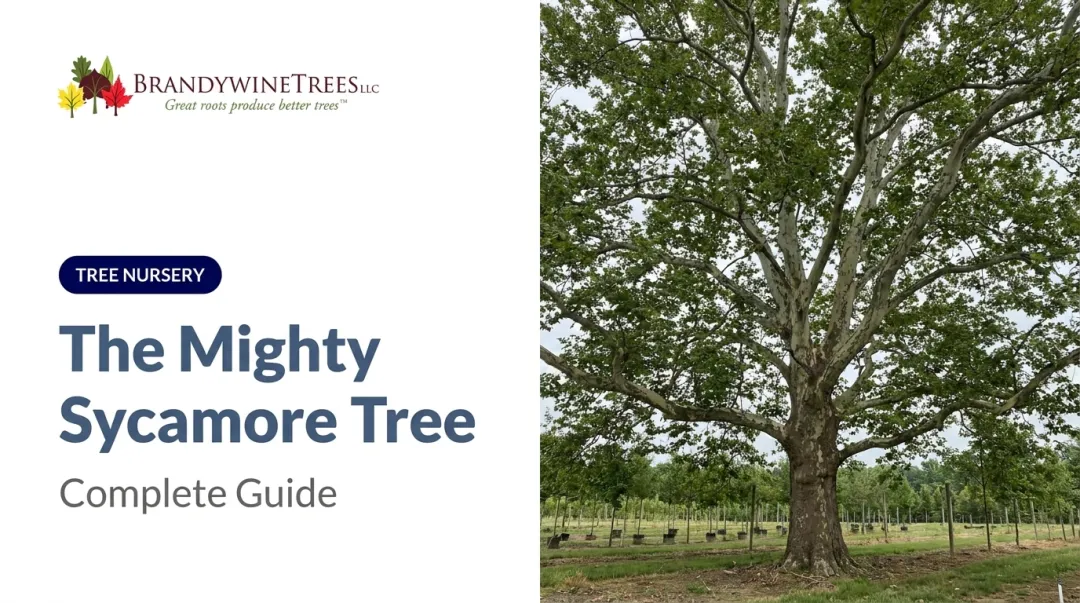

That's American Sycamore (Platanus occidentalis), and winter is its best season. Many homeowners and land stewards notice this tree along waterways, old farm lanes, and historic streets but have no idea what it's called, whether it's worth planting, or what makes its bark do that.
This guide covers how to identify American Sycamore in winter, what makes it botanically unusual, its wildlife and landscape value, and what to weigh before planting one, with insight from Brandywine Trees' growers woven throughout.
Key Takeaways
- Peeling patchwork bark forms when rigid outer tissue can't stretch as the trunk grows fast.
- Winter ID needs three clues: pale flaking bark, stalked seed balls, and a bud under the leaf scar.
- Mature trees commonly live 200+ years, with documented specimens surpassing 400.
- Persistent seed balls and hollow trunks make this species a genuine winter wildlife resource.
- Full sun, consistent moisture, and 60+ feet of room are non-negotiable for a healthy, long-lived sycamore.
Why American Sycamore's Bark Steals the Winter Show
Most trees have bark that stretches and cracks gradually as the trunk thickens. Sycamore bark doesn't play by those rules. It's stiffer and less elastic than the bark on species like maple or oak, so it simply can't expand at the same pace as the wood underneath it.
The result: the outer bark splits and sheds in large, irregular plates, exposing the smooth, pale tissue beneath. It's a completely normal growth process, and one of the tree's signature features.
What you'll actually see on the trunk:
- Patches of gray-brown and greenish bark near the base
- Cream and pale-tan tones higher up the trunk
- Almost pure white bark on the upper trunk and major limbs of mature trees
- A mottled, camouflage-like pattern that grows more dramatic with age
That pale upper bark is what makes a mature sycamore visible from a quarter-mile away in a leafless winter landscape—especially along a stream corridor where little else competes for attention.
Add in the tree's irregular, open branching habit, and you get real sculptural character once the leaves drop.
Round, fuzzy seed balls, often called buttonballs, dangle from long stalks and hang on through much of winter. Late-season winds break them apart and release the fluffy seeds.
Bark, silhouette, and lingering fruit are why landscape designers keep turning to sycamore for cold-season interest.
How to Identify American Sycamore in Winter (and What Gets Mistaken for It)
Bark alone can fool you. The most reliable winter identification stacks several features together, since a couple of other trees share the peeling-bark trick.
Look for this combination:
- Bark: patchy white, cream, and gray, especially on the upper trunk
- Trunk: thick; older trees often fork into large secondary trunks and a broad, open crown
- Seed balls: round, fuzzy, ½–1 inch wide, hanging singly on a 3–6 inch stalk
- Buds: one reddish, cap-like scale on a lateral bud, exposed in winter at the swollen old leaf-stalk base
Trunk girth is another giveaway. Sycamores develop some of the widest trunks of any native eastern hardwood, occasionally exceeding 10 feet in diameter. Old specimens frequently hollow out at the heartwood, leaving cavities that are easy to spot on a leafless winter tree.
Trees Commonly Confused With American Sycamore
Two species get mistaken for it constantly, and for different reasons.
| Species | Bark & Fruit | Key Difference |
|---|---|---|
| London Plane (Platanus x hispanica) | Similar mottled bark; seed balls usually hang in pairs on one stalk | Paired seed balls (not single); common street and park tree in cities |
| Sycamore Maple (Acer pseudoplatanus) | Scaly bark with orange patches; fruit is a winged seed pair, not a ball | Different genus entirely (Acer, not Platanus); name overlap is coincidental |
The quickest field check: true American Sycamore carries one round, fuzzy seed ball per stalk and shows the palest, most extensively flaking upper bark of the three. If you see paired balls, you're likely looking at London Plane. If you see winged fruit and no balls at all, it's Sycamore Maple, not a sycamore at all.
Size, Age & Lifespan of American Sycamore
Few native hardwoods in the eastern U.S. get as big as the American sycamore. Mature trees typically reach 70-100+ feet tall, with a canopy spreading nearly as wide, according to NC State Extension's plant profile.
The National Champion Tree Program's registered specimen in Ashland County, Ohio measures 124 feet tall with a 432-inch trunk circumference and an 88-foot crown spread—a clear example of how far the species can go with time and the right bottomland site.
Lifespan and Aging
- American Sycamores are long-lived, commonly surviving beyond 250 years in favorable conditions, per the U.S. Forest Service's species database
- Clemson Extension documents South Carolina's Bonsall Buttonwood at an estimated 400+ years old
- As trees age, the heartwood softens naturally, hollowing out the trunk while the living outer wood keeps growing
- Historical accounts describe colonial-era families using hollow sycamore trunks for shelter and even stabling livestock inside them

Young trees grow fast, often adding significant height within a couple of decades, which is why landowners with room to spare favor the species. You get a genuinely massive shade tree within a human lifetime, not just a legacy for the next generation.
Winter Wildlife Value of American Sycamore
A bare sycamore in January still feeds and shelters wildlife when most food sources have dried up.
Seed balls as winter food: Those persistent buttonballs are a high-protein food source for birds and small mammals during lean months. Goldfinches, chickadees, dark-eyed juncos, and squirrels all rely on the seeds.
Cavities for shelter: Hollow trunks and branch cavities, easy to spot once leaves are gone, provide nesting and denning sites for:
- Barred owls and eastern screech-owls
- Woodpeckers
- Wood ducks
- Chimney swifts
Sap activity kicks off late winter: As temperatures start to rise, sapsuckers begin drilling wells in sycamore bark, tapping the rising sap. Those wells also attract insects, which draws in other birds and starts a small food web weeks before spring arrives.
Is the American Sycamore Valuable?
The honest answer depends on what kind of value you're asking about.
Landscape value: As a fast-growing native shade tree, a well-placed sycamore genuinely enhances a larger property's curb appeal. It's not a fit for every yard, but on a sizable lot or near a water feature, few native trees make a bigger visual statement, especially in winter.
Wood value: Sycamore lumber has real, practical uses, including butcher blocks, boxes, drawer parts, and furniture components. That said, it isn't a premium timber species. Purdue's forestry program notes it isn't highly valued commercially and ranks lower in strength than oak or walnut. Think useful, not prized.
Collector and rarity value: Large, old-growth, or unusually shaped sycamores draw genuine interest from tree enthusiasts.
For buyers who want one in the ground, Brandywine Trees carries American Sycamore as a straight, well-formed specimen in sizes from 5–6 feet through 9–12 feet. It’s a practical wetland or shade choice with strong, well-developed roots—not a novelty item.
Planting Considerations for a Standout Winter Landscape Tree
Sycamore rewards the right site and punishes the wrong one. Get the placement right, and you'll have a fast-growing, long-lived tree with unmatched winter presence.
What it needs:
- Full sun
- Consistently moist, well-drained soil that parallels natural floodplain conditions
- At least 60 feet of open space for the mature canopy
Where to avoid it: Tight urban streets and sidewalk strips are a poor match. Limited root space combined with heat and reflected light increases stress.
Sycamores given room and steady moisture leaf out strongly each spring, even after a cool, wet start to the season.
Better fits:
- Large residential lots
- Naturalized or restoration plantings
- Sites near ponds, streams, or wetland buffers with open ground beneath the canopy
Site choice is only half the job—how the tree is grown and handled shapes those first weeks in the ground. Brandywine Trees, a licensed wholesale nursery on a private family farm in Chester County, Pennsylvania, grows American Sycamore among its native offerings as Transplant Ready Trees™, with up to 100% of the fibrous root system intact.

Certified Arborists and Licensed Growers know each tree's growth history firsthand, which matters for a species that needs steady moisture during its first 45-60 days after planting. They deliver throughout Pennsylvania and Delaware, with custom shipping available for larger orders elsewhere.
Frequently Asked Questions
What is the average lifespan of the American sycamore?
American sycamores commonly live 200+ years, and the U.S. Forest Service has documented trees beyond 250 years. Specimens such as South Carolina's Bonsall Buttonwood are estimated at over 400 years in favorable bottomland conditions.
What trees are commonly mistaken for the American sycamore?
London plane and sycamore maple (Acer pseudoplatanus) are the most frequent look-alikes. A single seed ball per stalk and heavily flaking white upper bark are hallmarks of true American sycamore.
Is the American sycamore valuable?
Yes—mainly for landscape and wildlife value, plus practical (not premium) timber uses such as butcher blocks and furniture components. Large or unusually shaped specimens also attract collectors and tree enthusiasts.
Why does American sycamore bark peel in large patches?
Its outer bark is more rigid than most trees and can't stretch as the trunk grows quickly. Instead, it cracks and sheds in plates, exposing the smooth, pale inner bark underneath.
Is American sycamore a good tree to plant near a house or street?
Generally, no. It's better suited to large, open, consistently moist sites where the roots get a full run, rather than tight urban plantings.
How fast does American sycamore grow?
It's a fast-growing species that puts on height quickly in its first few decades, then slows as it matures into its massive adult form.