Homeowners, landscape architects, and municipal planners often want this kind of fast-growing, resilient native tree. The trick is knowing how to identify one, how to care for it properly, and where to actually source a healthy, transplant-ready specimen. This guide covers all of it: the sycamore's defining features, its growth rate and lifespan, what it symbolizes, and step-by-step planting and care instructions.
Key Takeaways
- American sycamores grow fast, live long, and thrive in poor soil, pollution, and wet ground
- Exfoliating, multi-colored bark and a massive canopy make sycamores instantly recognizable
- Mature trees reach 75-100+ feet tall, so site selection matters
- Correct planting depth, spacing, and watering determine transplant success
What Makes the Sycamore Tree Special?
No other native shade tree combines rapid growth, enormous mature size, and extreme longevity quite like the American sycamore. It routinely outgrows oaks and maples in its first few decades, then keeps living for centuries after those trees have died back.
Add in a tolerance for wet soil, compacted urban ground, and pollution that would stress most species, and you have a tree that thrives in floodplains, city parks, and suburban yards alike. Few native trees check all these boxes at once.
Identifying Features: Bark, Leaves & Canopy
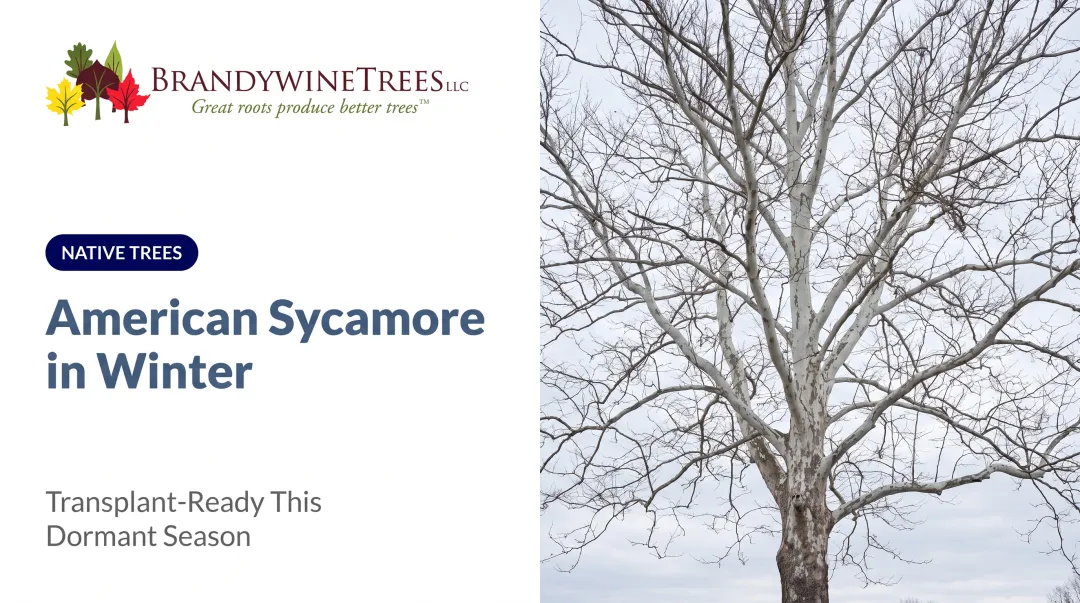
The sycamore's signature trait is its exfoliating "jigsaw puzzle" bark. As the trunk expands each year, the outer bark can't stretch to keep pace. It's too rigid, so it cracks and peels away in irregular patches, revealing white, tan, and olive-green inner bark underneath.
Leaves and canopy details:
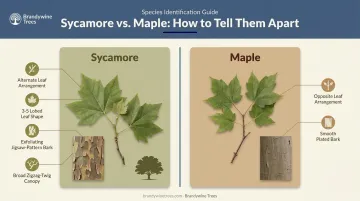
- Leaves: Alternate arrangement, simple, palmately veined, typically 4-8 inches wide with 3-5 shallow lobes and coarsely toothed edges
- Maple lookalike, but different: Maple leaves grow in opposite pairs; sycamore leaves alternate along the stem, one at a time
- Canopy: Broad and dense on open-grown trees, sometimes reaching 100 feet across, with stout, zigzagging twigs and heavy, spreading branches
Fascinating Sycamore Facts
Beyond identification, sycamores carry some genuinely surprising history.
In 1971, Apollo 14 command module pilot Stuart Roosa carried roughly 2,000 tree seeds, including sycamore, in lunar orbit. NASA and the U.S. Forest Service later germinated them into what became known as "Moon Trees".
One documented survivor grows outside the Visitor Center at NASA's Goddard Space Flight Center in Greenbelt, Maryland, planted on June 9, 1977.
The species also has a Wall Street connection. On May 17, 1792, 24 stockbrokers signed the Buttonwood Agreement, the founding document of what became the New York Stock Exchange. "Buttonwood" is simply another common name for the American sycamore.
The popular detail that it happened outdoors under a specific tree at 68 Wall Street, however, is widely considered folklore rather than confirmed fact.
For sheer scale, Ohio's national champion sycamore in Ashland County measures an astonishing 436 inches in trunk girth, stands 100 feet tall, and spreads 101 feet across its crown. Few native hardwoods ever approach a trunk that size, which shows just how large a sycamore can grow given enough room and time.
Sycamore Tree Growth Rate, Size & Lifespan
Platanus occidentalis belongs to the family Platanaceae, a small group of trees often called planetrees. Knowing the botanical name helps when cross-referencing university extension resources or ordering from a wholesale grower's catalog.
Native Range & Growing Zones
American sycamores thrive across USDA Hardiness Zones 4-9. Their native range stretches from southwestern Maine and southern Ontario west through Wisconsin, Iowa, and Nebraska, south through Kansas, Oklahoma, and central Texas, and east to northwestern Florida and southeastern Georgia.
They're especially common along riverbanks and floodplains, where consistent soil moisture supports rapid growth. Both Pennsylvania and Delaware list the American sycamore as a native species, which makes it a natural fit for landscaping projects across the Mid-Atlantic.
The species also tolerates compacted urban soils and periodic flooding, conditions common throughout the Delaware Valley's floodplains and stream corridors. This adaptability explains why municipal foresters and reforestation projects across the region frequently select sycamores for streambank stabilization.
How Big and How Fast Do Sycamores Grow
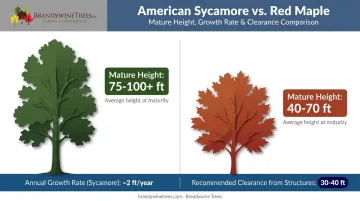
Sycamores are fast growers. Clemson University's extension service puts the typical growth rate around 2 feet per year, with mature trees reaching 75 to 100 feet tall and a similar or greater spread. Under ideal moist, deep-soil conditions, exceptional specimens have been recorded up to 175 feet.
Compare that to a red maple, which usually tops out around 40-70 feet, and the difference in scale becomes obvious. Sycamores need more room, both above and below ground, than most common shade trees. This mature footprint means sycamores need at least 30 to 40 feet of clearance from structures, power lines, and other trees when planted as young transplants.
Lifespan: A Tree That Outlives Generations
Clemson's research supports a reliable lifespan of 50 to more than 200 years. Some regional accounts describe old-growth individuals potentially reaching 500 to 600 years, though these ages aren't confirmed through core sampling or formal records; treat them as folklore rather than documented fact.
What is well established: hollow trunks are a common feature in aging sycamores and a mark of great age. Softened heartwood can persist for centuries while the living outer wood continues to grow. Those cavities also become valuable wildlife habitat.
- Black bears have been documented denning inside large hollow sycamore trunks
- Wood ducks regularly use sycamore cavities as nesting sites
- The tree's continued growth around a hollow core is part of what allows it to reach such advanced age
What Does a Sycamore Tree Symbolize?
Many people associate the American sycamore with strength and endurance, an association rooted in what the tree physically represents. A canopy wide enough to shade an entire yard and a trunk that survives for centuries reflect that endurance, while a root system anchoring through floods adds staying power of its own.
Documented history adds real weight here. Several Native American tribes recorded practical and medicinal uses of the tree:
- Cherokee communities used inner-bark infusions to treat dysentery
- Delaware peoples brewed bark infusions for colds and sore throats
- Iroquois groups used bark and root infusions as foot soaks for rheumatism
These recorded practices show how central the tree was to communities living alongside it for generations. The "sycamore" mentioned in biblical texts is a different species altogether: the sycamore fig native to the Middle East, not the American sycamore covered here.
Because of its scale and staying power, the American sycamore remains a common choice for memorial plantings and public spaces where a lasting, protective presence matters.
How to Plant & Care for a Sycamore Tree
Fall, after leaf drop, and early spring, before bud break, are the best windows for planting a sycamore. Both fall within the tree's dormant season, which minimizes transplant stress. Summer planting is possible but requires significantly more attentive watering to prevent the young tree from drying out during establishment.
Best Time & Method to Plant
Correct planting technique matters more than most people expect:
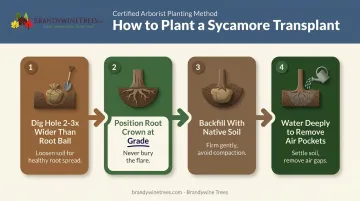
- Dig the hole 2-3 times wider than the root ball, but no deeper than the root ball itself
- Position the root crown so the trunk flare remains slightly visible above grade after settling
- Backfill with native soil, avoiding heavily amended mixes that can discourage roots from spreading outward
- Water deeply immediately after planting to eliminate air pockets around the roots
Given the sycamore's eventual 75-100+ foot spread, plant it well away from structures, driveways, and especially overhead or underground utility lines. A tree this large needs room both above and below ground to reach full size without conflict.
Ongoing Care: Watering, Fertilizing, Pruning
Newly planted sycamores need consistent watering, at least weekly in the absence of rain, more often during hot, windy stretches through mid-fall. Apply 2-3 inches of mulch around the base, but keep it pulled back 1-2 inches from the trunk itself.
Fertilizing: Skip it at planting time. Focus instead on root establishment first, fertilizing decisions are better made in consultation with an arborist once the tree shows active growth.
Pruning: Tidy any bent branches at planting time, then save structural pruning of healthy wood for the dormant winter months. Spent wood can come off anytime.
Seasonal Notes Worth Knowing
Two issues show up most often on American sycamores:
- A cool, wet spring: May mark the first flush of leaves and prompt a bushier second flush. Tidy the affected twigs during dormancy and the canopy fills back in by midsummer.
- A late-summer bloom on the foliage: A fine pale coating can appear on upper leaf surfaces in late summer and fall. It's purely cosmetic on leaves already on their way out.
Healthy, well-rooted trees generally shrug off both issues far more easily than stressed or poorly established ones, which is exactly why root quality matters so much at planting time.
Where to Buy Transplant-Ready Sycamore Trees
This is where sourcing quality actually shows up. A sycamore grown with a weak, circling root system will struggle to establish no matter how carefully you follow the planting steps above.
Brandywine Trees, a Pennsylvania-licensed wholesale nursery based on a family farm in Chester County, grows American sycamores as part of its Transplant Ready Trees™ lineup. These trees are propagated from seedlings and cultivated with attention to strong, fibrous root development, exactly the kind of root system that establishes quickly rather than sitting in transplant shock for a season or two.
A few practical details worth knowing:
- Wholesale pricing applies to orders of 3 or more trees (mix and match varieties)
- Direct delivery covers Pennsylvania and Delaware, with custom shipping available for larger orders elsewhere
- Professional planting services are available through a preferred contractor for quantity orders, useful for municipal streetscapes or larger residential projects
For sizing, current availability, or planting service quotes on sycamores specifically, reach out to Robert directly at Robert@BrandywineTrees.com or (610) 644-2636. He works directly with homeowners, landscape architects, and municipalities across the region and can speak to exactly what's in the field right now.
Frequently Asked Questions
What is special about sycamore trees?
American sycamores pair rapid growth and massive mature size with an exceptionally long lifespan and distinctive exfoliating, camouflage-patterned bark. Few other native shade trees grow this fast, this large, or live this long.
What does a sycamore tree symbolize?
Many associate the sycamore with strength, protection, and endurance, reflecting its long lifespan and wide, sheltering canopy. Several Native American tribes also recorded practical medicinal uses of its bark.
How fast do sycamore trees grow?
American sycamores typically grow around 2 feet per year under good conditions, making them one of the faster-growing native shade trees. Moist, deep soil supports the fastest establishment.
How long do sycamore trees live?
Documented lifespans commonly range from 50 to more than 200 years. Some accounts describe specimens reaching 500-600 years, though these ages aren't formally verified.
How close to a house should you plant a sycamore?
Bark shedding and heavy leaf drop can create seasonal cleanup, and mature root systems need room to spread. Plant sycamores well away from structures, driveways, and utility lines to avoid conflicts.
What is the difference between a sycamore and a maple tree?
Sycamore leaves grow in an alternate arrangement with thin, exfoliating bark, while maple leaves grow opposite each other with smoother, plate-like bark as they age. Sycamores also typically grow larger, reaching 75-100+ feet versus a maple's more common 40-70 feet.