
Getting the planting right is what unlocks that speed. Give it room from the house, water steadily through the first season, and prune in the right window, and you set the tree up for a long, productive life.
This guide walks through planting steps, ongoing care, routine seasonal notes, and answers to the questions people ask most, including timing, spacing, and how to tell whether this tree suits your yard.
Key Takeaways
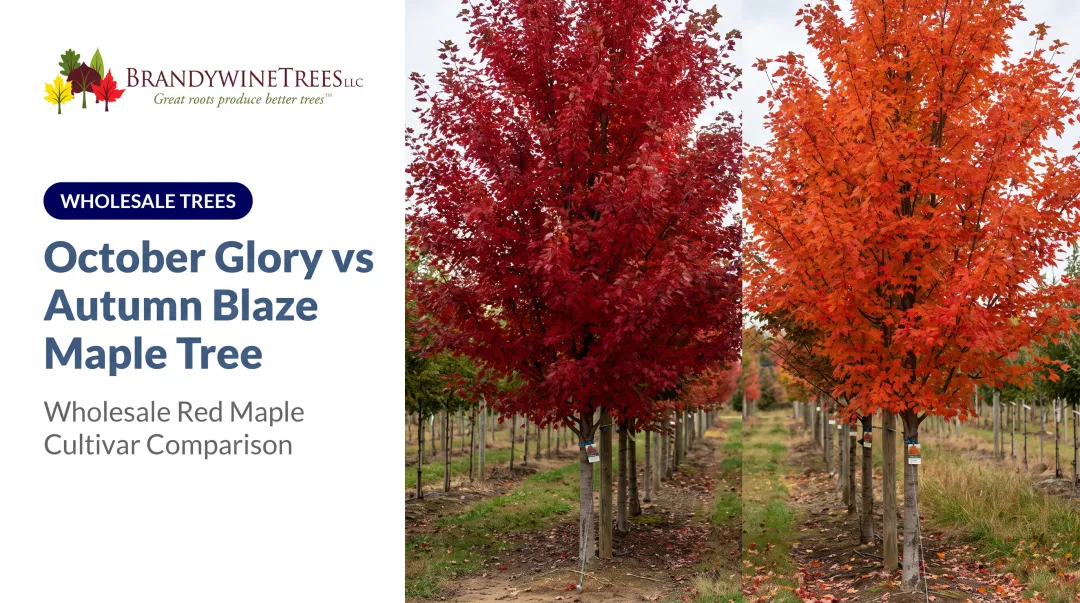
- Autumn Blaze Maple is a fast-growing hybrid reaching 40-60 feet with vivid orange-red fall color
- Plant in early spring or fall in full sun and well-drained, slightly acidic soil
- Keep 25 feet of clearance from the house to accommodate mature canopy and root spread
- Low-maintenance once established; a structural prune every few years keeps the framework strong
- Well-rooted stock like Brandywine Trees' Transplant Ready Trees™ establishes faster than bare-root
Autumn Blaze Maple at a Glance
Autumn Blaze (Acer x freemanii 'Jeffersred') is a Freeman maple — a deliberate cross of Red Maple and Silver Maple. It takes the brilliant fall color of one parent and the vigorous growth of the other, outpacing most shade trees in the landscape.
According to the University of Minnesota's UFOR Nursery & Lab, mature trees reach 40-55 feet tall and 30-40 feet wide. Morton Arboretum cites specimens up to 60 feet.
It is hardy across USDA zones 3-8, covering most of the continental United States.
Autumn Blaze falls in the soft maple group. Utah State University Extension notes that soft maple wood is lighter than hard maple, which is worth knowing when you plan placement and pruning.
| Attribute | Detail |
|---|---|
| Common Name | Autumn Blaze Maple |
| Botanical Name | Acer x freemanii 'Jeffersred' |
| Mature Size | 40-55 ft tall x 30-40 ft wide |
| Sun Exposure | Full sun to part shade |
| Soil Type/pH | Medium-to-wet, well-drained, acidic preferred |
| Hardiness Zones | 3-8 |
| Wood Type | Soft maple (lighter than hard maple species) |
How to Plant an Autumn Blaze Maple Tree
Best Time to Plant
Early spring or fall gives your Autumn Blaze Maple the strongest start. Both seasons bring reliable rainfall and moderate temperatures, letting roots establish well ahead of summer heat or winter cold.
The University of Illinois Extension specifically lists maples among species suited for fall planting. Aim for 4-6 weeks before your area's first hard frost if planting in autumn.
Summer planting works too, with closer attention to irrigation while the roots settle in.
How Far from the House to Plant
This tree needs room. An Extension horticulturist recommends 25 feet of clearance from the house for Autumn Blaze Maples, citing the tree's eventual 40-60 foot height and shallow root system (Ask Extension, 2019).
Why so much space?
- The canopy spreads 30-40+ feet wide at maturity
- Shallow, spreading roots want open ground rather than a strip beside paving
- Underground utilities need clearance before you dig, regardless of species
Site Selection & Soil Preparation
Full sun brings out the most vivid fall color, though the tree tolerates partial shade reasonably well. Before planting, test your soil's drainage:
- Dig a hole 12 inches wide, deep, and long
- Fill it with water and let it drain completely
- Refill it and time the drainage
According to the Morton Arboretum, water should drain within 24 hours. Slower drainage means you'll want to amend the site or pick a spot that drains more freely.
Planting Steps
Once you've selected the site, follow these steps:
- Dig the hole 2-3 times wider than the root ball, but only as deep as the root ball itself
- Position the trunk flare so it remains visible above the soil line after backfilling
- Backfill gently but firmly, watering periodically as you go to eliminate air pockets around the roots
- Water deeply immediately after planting to settle the soil
- Mulch 2-4 inches deep, keeping a 1-2 inch gap between the mulch and the trunk so the bark stays dry

The stock you start with matters just as much as the technique. Trees grown as Transplant Ready Trees™, like those produced by Brandywine Trees, are root-pruned in bags or pots rather than field-dug.
That process preserves nearly all the feeder roots and keeps them growing outward. The result is faster establishment than bargain nursery stock or bare-root trees that leave much of their root mass behind.
Autumn Blaze Maple Care Guide
Watering Schedule
New trees need consistent moisture while roots establish. The University of Minnesota Extension recommends:
- Days 1-14: Water daily
- Weeks 3-12: Water every 2-3 days
- After week 12: Water weekly until fully established
Apply 1-1.5 gallons per inch of trunk caliper at each watering. Established trees need supplemental water only during extended dry spells, at a rate of about 10 gallons per inch of caliper.
Fertilizing
Skip fertilizer entirely during the first year. Healthy landscape trees often don't need it at all, according to University of Maryland Extension.
If a soil test shows a genuine deficiency:
- Use a slow-release, nitrogen-rich fertilizer
- Apply in late fall or late winter
- Hold off in late summer and during dry spells
Pruning Practices
Prune maples when sap flow is low to limit the "bleeding" they're known for. Two windows work structurally:
- Best: Late fall through very early spring (dormancy)
- Alternative: After leaves fully emerge in early summer, if bleeding bothers you cosmetically
Key pruning rules:
- Never remove more than 25% of the canopy in a single session
- Take out suckers, spent wood, and crossing branches first
- Thin tight branch joints every 2-3 years so the canopy carries weight evenly
Mulching & Seasonal Care
Maintain a consistent 2-4 inch mulch ring year-round, refreshing it as it breaks down. Seasonal checklist:
- Spring: Walk the canopy after winter, check mulch depth
- Summer: Monitor watering during heat waves
- Fall: Rake up fallen leaves, prune dormant wood
- Winter: Wrap young trunks to keep bark temperature even
Routine Care Notes: Foliage, Structure & Roots
Autumn Blaze Maples ask for very little, and a few seasonal habits cover nearly all of it.
Foliage in humid seasons: Spotting on lower limbs after a run of humid weather is a common seasonal pattern, and canopies carry on unbothered. Prune to improve airflow and rake up fallen leaves each autumn to keep the following spring clean.
Insect visitors: Young Freeman maples occasionally host a few common garden insects, according to NC State Extension. Worth a glance during your spring walk-around:
- A sticky residue or dark film on the leaves
- A fine mottling across the leaf surface
- Small entry holes in bark (trunk tunnellers)

Insecticidal soap handles most soft-bodied visitors without harsh chemicals. Trunk tunnellers call for a targeted treatment or a certified arborist.
Branch structure: As a soft maple, this tree builds fast, light wood, so a structural prune every 2-3 years to open tight crotch angles is the single highest-value habit for a long-lived specimen.
Surface roots: Shallow roots gradually rise through lawns, especially in compacted or wet soil. Give the tree an open lawn setting rather than a narrow bed beside a walkway, and the root flare becomes a feature rather than something to mow around.
Leaf color in alkaline soil: Pale leaves in alkaline ground point to iron that's present but not chemically available. A soil test confirms it, and EDDHA-chelated iron treatments restore deep green color for 1-2 years per application.
Is an Autumn Blaze Maple Right for Your Yard?
What it gives you:
- Rapid growth compared to most shade trees
- Reliable, vivid orange-red fall color every year
- Adapts to clay, wet, or dry soil once established
- Minimal seed drop (flowers and fruit are sparse)
- Dense canopy provides strong shade coverage within a decade
What to plan for:
- Fast, light wood that rewards a structural prune every few years
- An open setting where the canopy can carry weight evenly
- Shallow roots that prefer lawn to a tight bed beside paving
- A 25-foot setback from foundations and hardscaping
So who should plant one? If you've got a large yard and want fast shade without a decade-long wait, Autumn Blaze delivers. On a small lot or right up against structures, sidewalks, or utility lines, a slower-growing hardwood with a deeper root system is the easier long-term fit.
If Autumn Blaze fits your site, source transplant-ready stock from a grower that knows the tree's history. Brandywine Trees offers the variety at wholesale on mix-and-match orders of three or more, with Certified Arborist planting services available for quantity orders across Pennsylvania and Delaware.
Frequently Asked Questions
When should I plant an Autumn Blaze Maple tree?
Plant in early spring or fall, ideally 4–6 weeks before the first hard frost if planting in autumn. Cooler temperatures and steadier rainfall help roots establish before summer heat or winter cold.
What are the pros and cons of planting an Autumn Blaze Maple?
Pros: fast growth, vivid fall color, and broad soil adaptability. To plan for: light, fast-grown wood that benefits from a structural prune every few years, and shallow roots that do best in open lawn.
How far should I plant an Autumn Blaze Maple tree from the house?
Keep at least 25 feet of clearance from foundations, driveways, and utilities. This accommodates the tree's eventual 40-60 foot height and its shallow, spreading root system.
How fast does an Autumn Blaze Maple grow?
Autumn Blaze is a fast-growing shade tree that typically outpaces most hardwoods. With consistent watering and good site conditions, it reaches mature height sooner than slower species such as oaks or sugar maples.
How long do Autumn Blaze Maple trees live?
Lifespan depends on care and site conditions; university extensions do not publish a fixed figure for this cultivar. Regular pruning and structural maintenance help it live a long, healthy life.
How do Autumn Blaze Maple roots behave?
Roots are shallow and gradually surface through lawns, and NC State Extension notes the hybrid roots more conservatively than its Silver Maple parent. Planting 25+ feet from structures and hardscaping gives them the run they want.