
Many buyers assume a young tree will fill out and start peeling within a couple of seasons. It won't. Understanding how fast — or slow — this tree actually grows matters for budgeting, landscape timelines, and knowing when those signature bark features will show up.
This guide breaks down real growth rate ranges, how growth shifts across life stages, what actually speeds it up, and how to give a newly planted tree its best shot at establishing quickly.
Key Takeaways
- Paperbark maple grows slowly, typically under 12 inches per year once established
- Mature height of 20–30 feet takes decades, not years
- Bark exfoliation and canopy fullness both take patience — there's no shortcut
- Root health and site conditions affect real-world speed far more than fertilizer
- Starting with a well-rooted, nursery-grown tree beats a stressed, field-dug specimen
Understanding Paperbark Maple's Growth Rate
In horticultural terms, growth rate refers to the annual increase in height and trunk caliper. Nurseries and arborists classify paperbark maple firmly in the "slow growing" category: generally under 12 inches of height gain per year once a tree is established.
The City of Princeton's municipal horticulture program cites an annual growth rate of roughly 6 to 12 inches for this species, matching the slow-growth range used by major arboretums and extension services.
Why paperbark maple grows slowly
Its native range offers a clue. Paperbark maple originates in the understory of mixed forests across central and eastern China, often growing beneath a canopy of taller trees in filtered light. Trees that evolve under those conditions tend to prioritize steady, efficient growth over rapid vertical gains. There's no light-competition reward for racing upward.
That same trait keeps the species compact, long-lived, and well suited to smaller landscapes.
Factors That Influence Growth Rate in Real-World Conditions
The "slow growing" label is a baseline. Actual speed in your yard depends heavily on site conditions and how the tree was grown before it ever reached you.
Root System Health Matters Most
A tree with a strong, undamaged root system establishes and grows measurably faster than one with circling, girdled, or transplant-shocked roots. This is the single biggest variable homeowners overlook.
Field-dug trees typically lose 85–90% of their feeder roots during harvest. That root loss translates directly into slower recovery and stalled growth for a season or more after planting.
Soil, Sunlight, and Water
- Soil: Tolerates clay but grows best in moist, well-drained, neutral-to-slightly-acidic soil. Compacted or poorly drained soil slows root expansion and top growth.
- Sunlight: Full sun to partial shade both work, but heavier shade can reduce vigor and dull fall color.
- Water: Consistent moisture during the first two to three growing seasons matters more than almost any other factor, since the tree hasn't yet developed meaningful drought tolerance.
Get these three right, and you give the tree every chance to grow at the faster end of its natural range.

Growth Rate Across Life Stages
Growth rate isn't a flat line. It shifts noticeably as the tree moves from seedling to established landscape specimen to full maturity.
Seedling and Transplant Establishment Stage
Newly transplanted young trees direct most of their energy into root establishment for roughly the first two to three years. Visible top growth often looks slower during this window, not because something's wrong, but because the tree is building its foundation underground first.
Root quality at planting time makes a real difference in how long that stall lasts. Brandywine Trees grows Transplant Ready Trees™ with organic methods focused on healthy root systems, so paperbark maples spend less of those early years recovering and more of them establishing in the landscape.
Juvenile to Semi-Mature Stage
Once established, growth settles into the typical 6–12 inch per year range. During this stage, the tree's form gradually shifts from an upright-oval juvenile habit toward a more rounded, spreading canopy as it matures.
Mature Growth and Timeline to Full Size
Reaching the species' mature height of 20–30 feet is a multi-decade process. This isn't a tree you plant expecting a full-size specimen within a decade.
The Arnold Arboretum's original 1907 paperbark maples offer a striking real-world data point. Both trees were still alive at 100 years old:
| Specimen | Height at Age 100 | Spread |
|---|---|---|
| Bradley Garden tree | ~64 feet | 44 feet |
| Chinese Path tree | ~30 feet | 38 feet |
Notice the gap between them. Same species, same introduction year, dramatically different sizes a century later. Site conditions shape outcomes even over very long timelines.
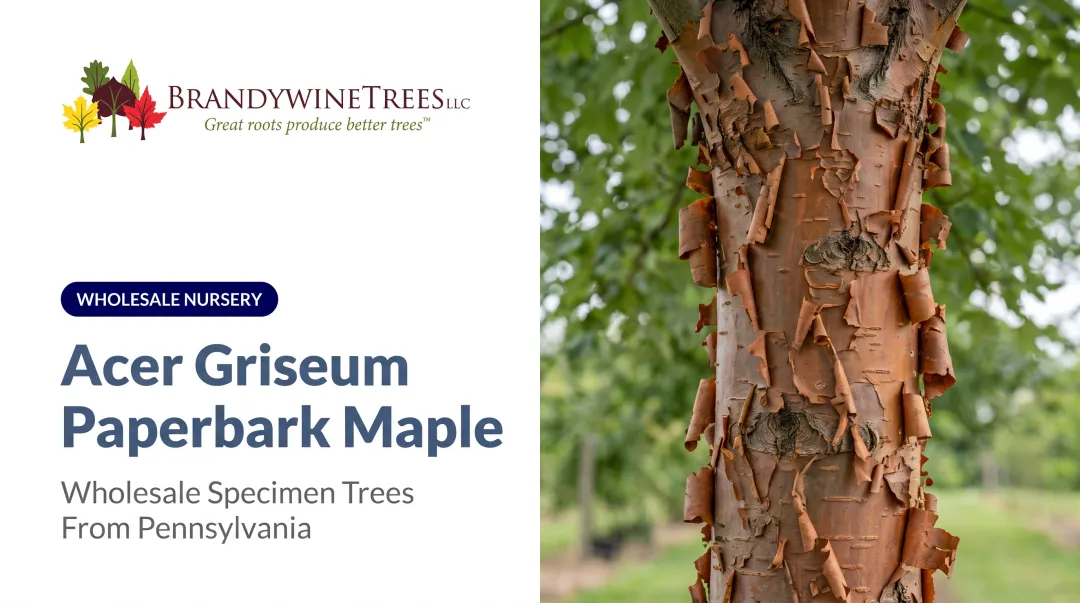
Bark development ties to age, not size. Exfoliation typically begins around year 6–7 and continues for the rest of the tree's life, regardless of how tall it's gotten by that point.
Why Steady Slow Growth Helps in the Landscape
This slow pace is consistent across the species. It's not something extra fertilizer will meaningfully speed up. The trade-off: a longer wait for full size, in exchange for a compact, long-lived ornamental tree that fits beautifully into small yards, patios, and even bonsai practice.
How to Support Healthy, Faster-Establishing Growth
You can't change the species' genetics, but smart establishment practices still help paperbark maple put on steadier early growth.
- Start with a well-rooted young tree. Field-dug stock with disturbed roots struggles after planting. Brandywine Trees' "Transplant Ready" paperbark maples go through two to three root-pruning pot-up stages, building dense, fibrous roots with added mycorrhizae.
- Water consistently for the first two to three seasons. Deep, regular watering drives root expansion instead of stress. Water a 4-foot circle around the root ball every other day in hot weather for the first 45–60 days.
- Mulch instead of fertilizing. Apply 3–4 inches of mulch across a 32–36 inch circle, keeping it off the trunk. Mulch holds moisture and steadies soil temperature. Extra fertilizer does little to speed this species' slow growth.
- Protect the trunk and time pruning carefully. Avoid mower and trimmer damage at the base, and save heavy pruning for dormancy. Poor cuts add stress and slow growth further.

Paperbark maples from Brandywine Trees typically ship at 4–5 feet up to 7–8 feet, in 10- or 15-gallon containers. Wholesale pricing runs $159–$189 per tree with the standard 3-tree minimum.
Common Misconceptions About Paperbark Maple Growth Rate
A few myths circulate often enough that they're worth addressing directly.
- "More fertilizer means faster growth." Not with this species. Slow growth is a genetic trait, not a sign of nutrient deficiency, so heavy feeding won't override it.
- "It should grow like a red or silver maple." Red and silver maples can gain a foot or more per year as seedlings. Paperbark maple is a different category of tree, so comparing timelines only sets you up for disappointment.
- "Bark should start peeling soon after planting." Exfoliation takes roughly six to seven years to begin, and a full, mature canopy takes decades. Neither shows up quickly.
- "First-year nursery growth predicts long-term speed." A strong spurt in a nursery pot often slows once the tree is in the ground and adjusting to landscape conditions.
Conclusion
Paperbark maple is genetically slow-growing. How fast it performs in your yard still depends on root health, site conditions, and care during establishment.
Start with a well-rooted young tree, water consistently, and mulch properly. That steady support builds a healthier specimen than any attempt to force faster top growth.
Frequently Asked Questions
How fast do paperbark maples grow?
Paperbark maples typically gain 6–12 inches in height per year once established. Growth is noticeably slower during the first two to three years after planting, while the tree focuses on root development.
How long do paperbark maples live?
Documented specimens live well past 100 years. Both of the original 1907 Arnold Arboretum trees were still alive at their centennial, so plan on a multi-generational landscape tree.
Does fertilizing a paperbark maple speed up its growth rate?
No. The slow growth rate is a genetic trait of the species, not a nutrient deficiency, so extra fertilizer has little meaningful effect. Mulch is a far better investment for supporting healthy establishment.
At what age does paperbark maple bark start to peel?
Exfoliation typically begins around year 6–7 and continues throughout the rest of the tree's life. It's tied to the tree's age rather than its overall size.
Are there faster-growing paperbark maple cultivars?
Interspecific hybrids like Gingerbread ('Ginzam'), a cross between A. griseum and A. nikoense, grow faster than the pure species while retaining attractive bark. It's a hybrid, not a standard Acer griseum selection.
How can I help a newly planted paperbark maple establish and grow faster?
Start with a young, well-rooted tree rather than a stressed field-dug specimen. Water consistently through the first few growing seasons, and mulch instead of fertilizing to hold soil moisture.